
11 m · BVLOS
X-11 Never landing platform
The X-11 is designed to stay on station for a full working day, carry up to 15 kg of sensors, and fly its missions automatically beyond visual line of sight.
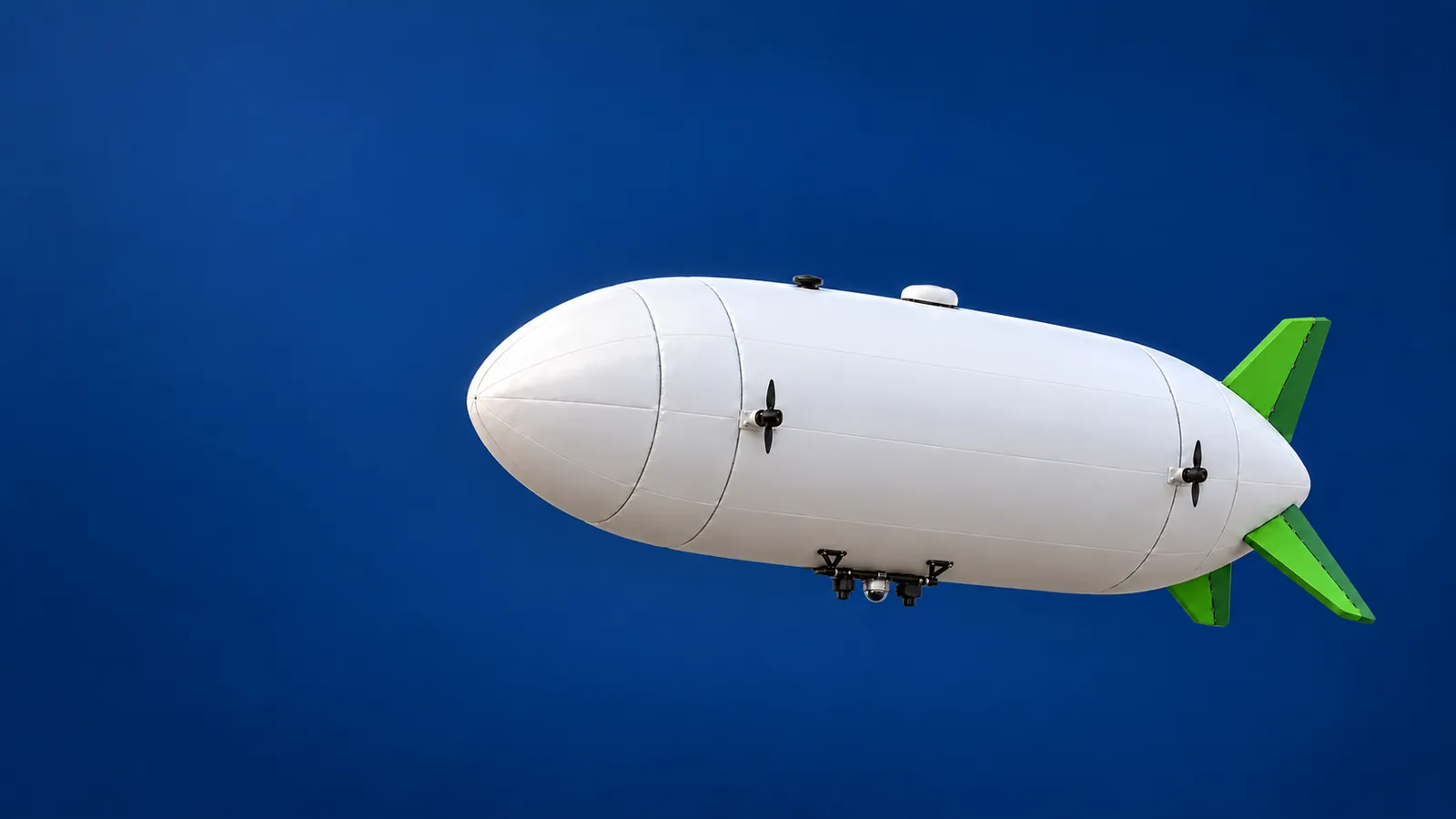 AI concept visual
- Endurance
- 10+h
- Payload, up to
- 15kg
- Cruise, software limit
- 43km/h
- Radio / 5G, satellite back-up
- 5G+ SAT
- Galileo HAS class
- 20cm
Design specifications of the X-11, verified step by step in our test programme.
Overview
Persistent sensing beyond visual line of sight.
Ideal for: long corridors and persistent observation beyond visual line of sight.
The X-11 combines a rigid carbon lattice frame, four vectoring propellers on rotating tubes, a Y-tail with three fins and flight control with our own control allocation.
Specifications
X-11 specifications
Values are design specifications, verified step by step in our test programme.
Airframe
| Parameter | Value | Unit |
|---|---|---|
| Length | 11 | m |
| Hull diameter | 2.1 - 2.3Geometry is being optimised | m |
| Hull volume | about 37 | m³ |
| Structure | Rigid carbon lattice frame; gas cells inside at near-ambient pressureFrame passes 9 load cases in finite-element analysis | - |
| Maximum take-off mass | 24.9 - 4324.9 kg in the EU open category, up to 43 kg | kg |
| Lifting gas | Helium/hydrogen | - |
Performance
| Parameter | Value | Unit |
|---|---|---|
| Endurance | 10+ | h |
| Cruise speed | 43Limited by software | km/h |
| Inspection altitude | 50 - 120 | m above ground |
| Structural wind case | 15 + gustsOperating wind limits will be set in flight tests | m/s |
| Noise | 37 - 38Measured in the flight-test programme | dB(A) at 50 m |
Payload
| Parameter | Value | Unit |
|---|---|---|
| Payload mass | up to 15For customer sensors | kg |
| Sensor classes | RGB, thermal, LiDAR, multispectral, gas and air analysers, RF | - |
| Data ownership | The customer keeps the payload data | - |
Connectivity and navigation
| Parameter | Value | Unit |
|---|---|---|
| Command and data link | Radio and 5G mobile network | - |
| Back-up link | Satellite terminal on boardTakes over where radio and 5G coverage drops | - |
| Positioning | Galileo HAS corrections, 20 cm class | - |
| Authenticated position and time | Galileo OSNMA | - |
| Weather planning | Satellite weather data in mission planning | - |
| Autopilot | Industry-standard open autopilot with our own vectored-thrust control allocation | - |
Operations and regulation
| Parameter | Value | Unit |
|---|---|---|
| Mission execution | Automatic waypoint missions, station keeping, geofence, link-loss failsafeIn development | - |
| Crew | 1 - 2Remote operator, with a ground handler when needed | people |
| Launch and recovery | Mobile mooring mast; no runway; transportable modules | - |
| Regulatory route | 24.9 kg, within visual line of sight: EU open category, no operational authorisation. Beyond visual line of sight (BVLOS), up to 43 kg: EU specific category; SORA 2.5 operational authorisation from the national aviation authorityILT in the Netherlands; other EU countries through the EU cross-border procedure. BVLOS operations from 2028 | - |
| Availability | Lease and sale from 2029 | - |
Payload and integration
Your sensors. Your data.
Up to 15 kg for customer sensors, with power for the payload.
- RGB and thermal cameras
- LiDAR
- Multispectral cameras
- Gas and air analysers
- RF receivers
We integrate the sensor with you. The payload data belongs to you.
Operations
How the X-11 is operated.
Crew of one or two
A remote operator, with a ground handler when needed.
No runway
Launch and recovery from a mobile mooring mast.
Transportable
The hull splits into nose, body and tail modules for a trailer.
Regulatory route
EU specific category, SORA 2.5 authorisation from the national aviation authority (ILT in the Netherlands). BVLOS operations from 2028.
Programme status
X-11 programme status.
The X-11 frame is selected from the virtual test campaign, and its propulsion and flight software are in test. The X-11 build follows the sub-scale flight tests.
-
2026
Completed
Vectored-thrust test bench
Rotating-tube propulsion pod tested on the bench.
Bench-tested -
2026
Completed
Flight control software
Autopilot with our own control allocation for four vectoring propellers and three fins, validated in simulation and on the bench.
Bench-tested -
2026
Now
Sub-scale model and first flight tests
Building the sub-scale model for indoor and outdoor tests of flight controls and autonomy.
-
2026
Now
Test site and authority preparation
Preparing test-site operations and the first meetings with the Dutch aviation authority (ILT).
-
2027
Next
Satellite link and navigation tests
Satellite back-up link and Galileo positioning tested in flight.
-
2028
Next
X-11 build and BVLOS test campaign
X-11 assembly, tethered and VLOS test rounds, then BVLOS corridor flights under an ILT authorisation.
-
2029
Next
X-11 launch series
Lease and sale with maintenance, spare parts and training.
FAQ
Questions about the X-11
What do VLOS and BVLOS mean?
VLOS means visual line of sight: the remote operator keeps the airship in direct view, without binoculars, and flies it within a few hundred metres. BVLOS means beyond visual line of sight: the airship flies further than the operator can see, following its planned route with the autopilot, precise positioning and a data link, under an authorisation from the aviation authority. The X-11 is built for BVLOS missions along long corridors.
How long can it stay airborne?
The X-11 is specified for 10+ hours on station. We publish measured values as the flight-test programme progresses.
How does it communicate beyond line of sight?
The X-11 is controlled over radio and the 5G mobile network. A satellite terminal on board is the back-up channel, so command and data links continue where terrestrial coverage drops.
How precise is its positioning?
We use Galileo HAS corrections (20 cm class) without local base stations, and Galileo OSNMA to authenticate position and time, which protects against spoofing. Station-keeping accuracy in wind will be measured in flight tests.
Is it allowed to fly, and in which EASA category?
Under EU drone rules an unmanned airship is an unmanned aircraft. The X-11 needs a specific-category operational authorisation, based on a SORA 2.5 risk assessment, from the national aviation authority: the ILT in the Netherlands. For flights in other EU countries we apply to the authority of that country through the EU cross-border procedure. We plan BVLOS operations of the X-11 from 2028.
When can we get one?
Lease and sale of the X-11 open in 2029, after its BVLOS test campaign. Until then we offer pilot projects and inspection flights.
Reserve the X-11.
Non-binding. Priority in the launch series and early access to flight-test results.